Let’s be honest. When a great educator hands in their notice, it’s rarely because they’ve fallen out of love with children.
I’ve sat across the table from enough resignation letters over the years to know the real story is usually somewhere else. The roster that never quite worked. The ideas they raised in a staff meeting that went nowhere. The lunch breaks that were frequently really twenty minutes standing next to the sleep room. The feeling that nobody noticed how hard they were trying.
Here’s the good news. Most of those things are within our control as leaders. And the changes that keep good people are often smaller than we think.

The real reasons educators leave
Pay matters. It always will, and our sector has a long way to go there. But pay is rarely the whole story, and it’s often not the part we can change on a Tuesday afternoon.
When educators talk openly about why they left a centre, the same themes come up again and again:
- They didn’t feel safe to speak up, ask questions or admit a mistake.
- The workload felt relentless, with no real breathing space.
- They raised concerns and nothing happened.
- Their effort went unnoticed, or was acknowledged in a vague, box-ticking way.
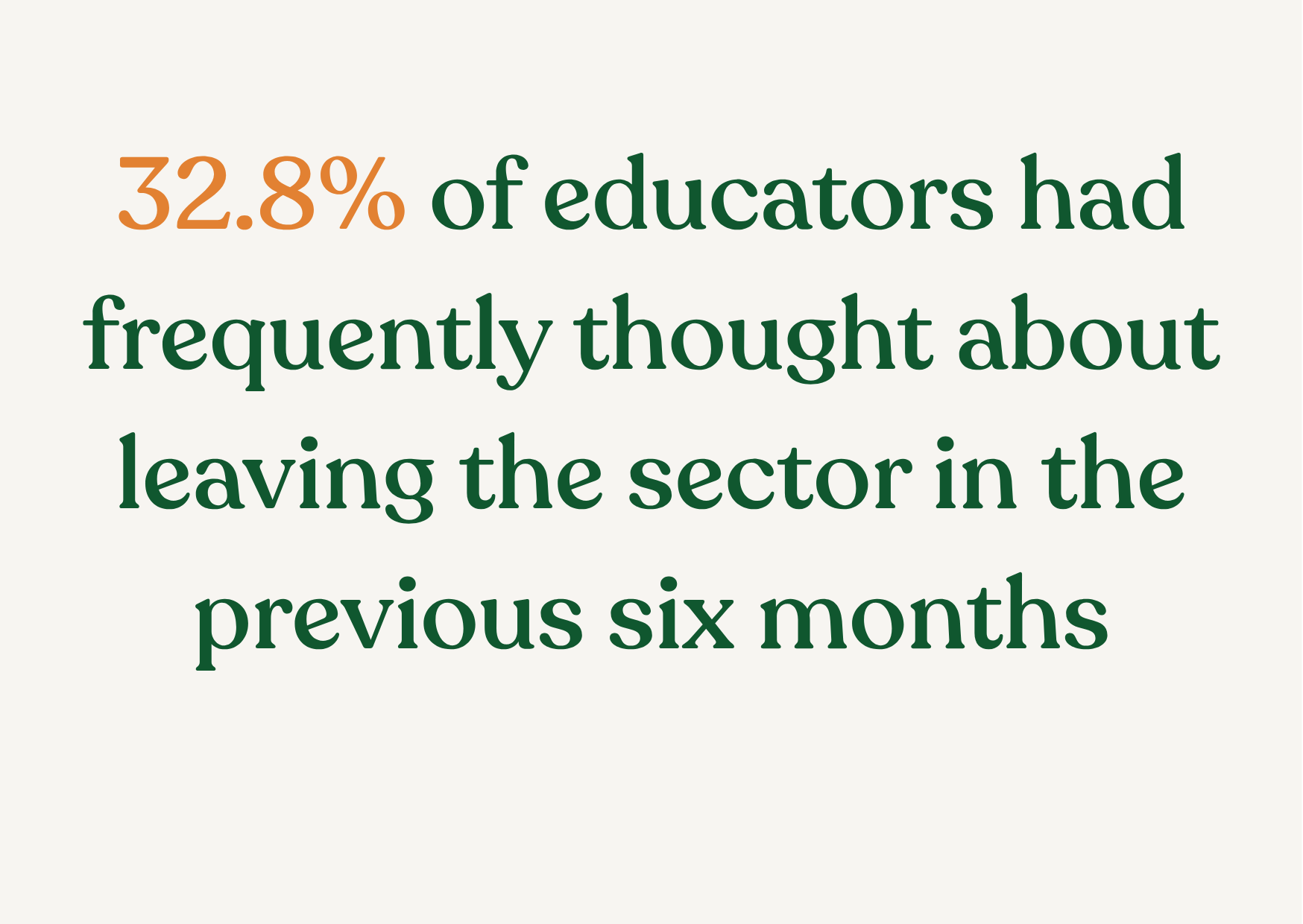
The numbers tell us how big this is. In New Zealand, NZEI Te Riu Roa’s 2025 early childhood workforce survey of more than 2,000 educators found that one in three (32.8%) had frequently thought about leaving the sector in the previous six months. The top reason was burnout, followed closely by workload and concerns about where the sector is heading.
Across the Tasman, a 2024 United Workers Union poll of more than 1,100 Australian educators found that 62% didn’t plan to still be in the sector three years from now. And 97% of centres had lost educators in the previous 12 months.
Let that sink in for a moment. These are people who chose this work because they care about children. They’re not running out of love. They’re running out of energy.
None of these come down to a lack of passion. They’re about culture, workload and leadership. Those three things decide who stays and who quietly starts browsing job listings on their phone at nap time.
So let’s look at each one.
Psychological safety: speaking up without fear
Psychological safety simply means people believe they can speak up, ask a “silly” question, disagree, or own a mistake without being embarrassed or punished for it.
In an ECE team, this matters enormously. Educators who feel safe will tell you when a child’s behaviour is worrying them, when a routine isn’t working, or when they’re not coping. Educators who don’t feel safe will keep quiet, and quietly burn out.
A few ways to build it:
- Go first. Share your own mistakes and what you learned. When a leader says “I got that one wrong,” it gives everyone else permission to be human too.
- Thank people for raising concerns, even when the timing is awkward or the news isn’t what you wanted to hear.
- Watch your reactions. A sigh, an eye roll or a sharp reply in a busy moment can undo months of trust.
- Make room for quieter voices. Not everyone will speak up in a staff meeting. Try one-on-one check-ins, anonymous suggestions, or asking for input before the meeting rather than during it.
What would your team say if you asked them: “Do you feel safe telling me when something isn’t working?” It’s worth asking. And it’s worth really listening to the answer.

Workload that’s sustainable: breaks, rosters and non-contact time
Our work is physical, emotional and constant. Educators give a lot of themselves every single day. If the workload never lets up, even the most passionate person will eventually run out of fuel.
Sustainable workload isn’t about doing less for children. It’s about protecting the people who care for them, so they can keep showing up well.
Breaks are non-negotiable. A real break means away from the floor, phone in hand or feet up, not supervising the sleep room while eating a muesli bar. If breaks are regularly cut short, that’s a signal your roster needs a look.
Rosters should be fair and predictable. Last-minute changes happen (we all know the 6am “I’m unwell” text). But when they become the norm, people can’t plan their lives. Share rosters early, spread the less popular shifts fairly, and ask your team what would make the roster work better for them.
Protect non-contact time. Planning, documentation and reflection need real time. When non-contact time is the first thing to go every time you’re short-staffed, educators end up doing it at home, at night, unpaid. And they already are: in the same NZ survey, 62% of educators said they did more than an hour of unpaid work every week, and more than one in five (21.3%) did more than an hour every day. That’s a fast track to resentment.
Check for hidden workload. Sometimes the load isn’t in the roster at all. It’s the extra admin task added “just this once,” the third new system this year, or the expectation to reply to group chats on a Sunday. Ask yourself: what could we stop doing, simplify, or share differently?
Leaders who listen and act
Listening is a wonderful start. But listening without action can actually do more damage than not asking at all.
When an educator raises an idea or a concern and then hears nothing more, the message they take away is “there’s no point.” Do that a few times and they stop raising things altogether.
Leaders who keep good people tend to do three things well:
- They close the loop. Even when the answer is “not right now,” they explain why and say when they’ll revisit it.
- They act on small things quickly. Fixing the broken gate latch or swapping the meeting time shows people their voice counts, and builds trust for the bigger conversations.
- They’re visible and approachable. They spend time on the floor, they know what a hard day in the toddler room actually looks like, and they’re easy to talk to.
You won’t be able to say yes to everything. Nobody can. But your team will forgive a lot when they can see you genuinely trying.
Recognition that’s specific and sincere
“Great job, everyone!” in the group chat is lovely. It’s also easy to forget by morning tea.
The recognition that really lands is specific. It tells someone exactly what they did and why it mattered.
Compare these two:
- “Thanks for your hard work this week.”
- “I noticed how calmly you supported Ollie through drop off on Monday. His mum told me it’s the first time he’s settled that quickly. That’s down to the relationship you’ve built with him.”
The second one takes thirty seconds longer. It will be remembered for months.
A few ideas to make recognition a habit:
- Notice the quiet contributors, not just the loudest or most visible.
- Make it personal. Some people love public praise. Others would rather a quiet word or a handwritten note.
- Connect it to children. Show people the difference their work is making. That’s what most of us came into this sector for in the first place.
- Build it into routines. A “shout out” moment at staff meetings, or a recognition board in the staffroom, keeps it from slipping when things get busy.
The thing to remember: Small, consistent changes to how a team works keep good people. You don’t need a big budget or a culture overhaul. You need to show up, notice, listen and follow through, again and again.

Where to start
If you’re reading this and thinking “we’ve got work to do,” you’re not alone. Every centre does. The fact that you’re thinking about it already puts you ahead.
Pick one thing. Maybe it’s protecting breaks next week, or asking your team one honest question at the next staff meeting. Start there, keep it consistent, and build from it.
Good educators are the heart of quality teaching for children. When we look after them well, children thrive. It really is that simple, and that important.
If you’d like to go deeper, join me for our webinar Building a Thriving ECE Workplace here. We’ll unpack practical strategies for culture, workload and leadership that you can take straight back to your team.
You’ve got this.
With warmth,
Angela
Angela Bush
Share your thoughts...