Picture the moment. A child hurls a block across the room, tears already falling before it even lands. Somewhere nearby, an educator takes a breath and tries to remember every strategy they have ever read about "managing behaviour."
Here's the thing though. That moment isn't waiting for a technique. It's waiting for you. Your calm, your voice, your steady presence, lent to a nervous system that can't do this alone yet. That's co-regulation, and it's quietly one of the most important things we do all day.
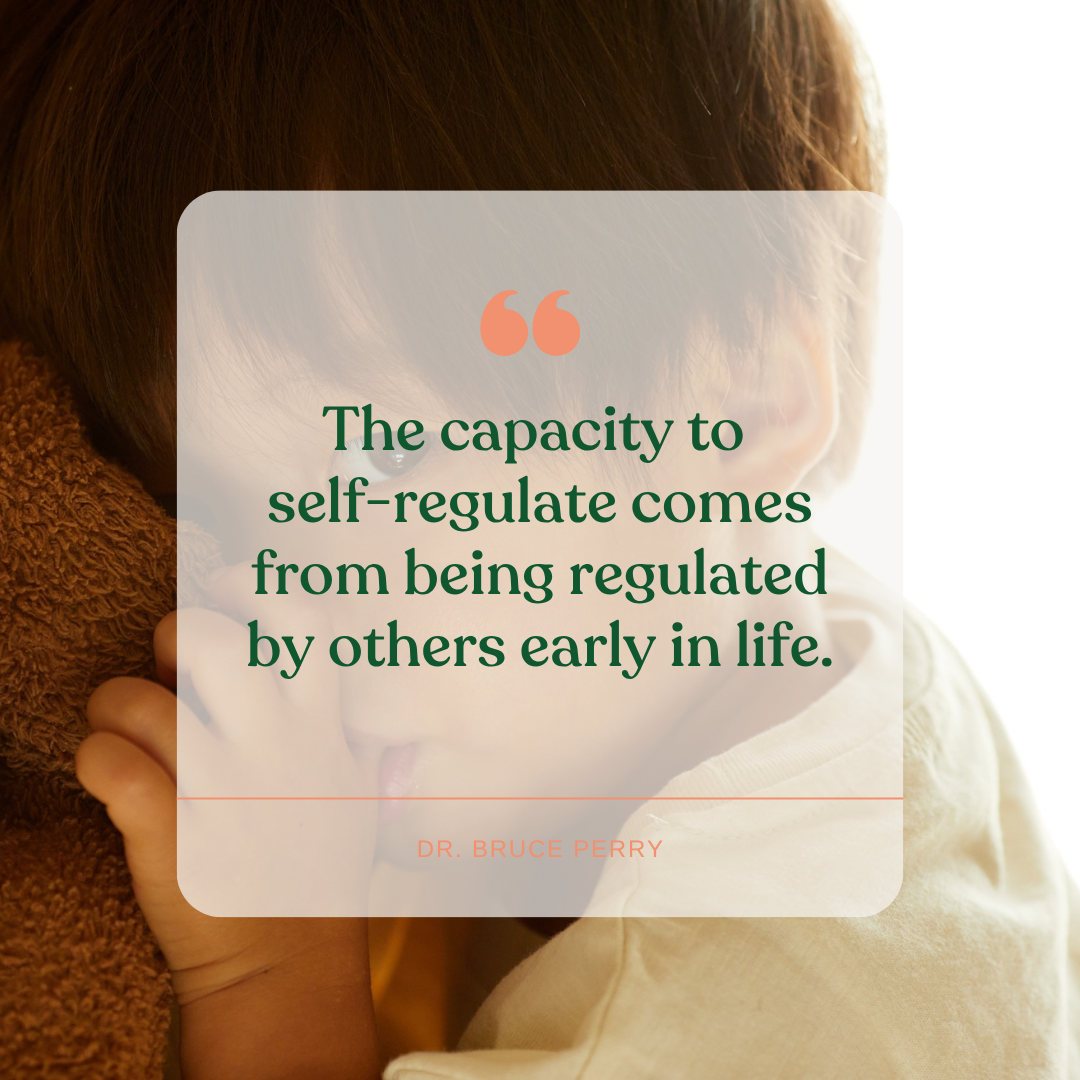
Self-regulation is the ability to notice a big feeling and find your own way through it. Co-regulation is what happens before a child can do that. It's us, lending our calm to a child who doesn't have any of their own to reach for yet.
Think of it like borrowing warmth from someone else's jacket on a cold day. A child doesn't generate calm themselves. They borrow yours, again and again, until slowly they start growing a little of their own.
This isn't a "nice extra." It's the actual mechanism through which self-regulation eventually develops. There is no shortcut to self-regulation that skips co-regulation first.
Young children aren't failing to calm themselves down. They literally can't, not reliably, not yet. The part of the brain responsible for that skill is one of the last to develop, and it doesn't finish the job until well into adulthood.
So when a child melts down over the wrong colour cup, they're not being difficult. They're being exactly as developed as they should be at that age, and they need a regulated adult nearby to borrow from.
This is why co-regulation belongs inside our curriculum thinking, not off to the side as a behaviour fix. Wellbeing, belonging, and relationships aren't a warm up act before the "learning" starts. Co-regulation is the learning, especially in the early years.

You don't need a whole new programme to do this well. You need to notice what you're already doing, and do it on purpose.
Here's your gentle nudge for the day. Children can't borrow calm you don't have.
- Before you respond to a meltdown;
- Take your own breath first.
- Drop your shoulders.
- Soften your voice before you even open your mouth.
- Children read our bodies long before they understand our words, so regulating yourself is the first, non-negotiable step of co-regulating anyone else.
Once you're steady, your language becomes the bridge. Naming what you see, calmly and without judgement, helps a child feel met rather than managed.
"You're stamping your feet. I think you're really frustrated that it's not your turn yet. I'm right here."
That's not a script to fix the moment. It's you, standing beside the storm instead of trying to talk someone out of having one.

Sometimes co-regulation needs almost no words at all. A hand on a shoulder, sitting at their level, staying close without rushing them toward "fine" too quickly.
Presence says something words can't always manage: I'm not going anywhere, and neither is my calm.
A calm corner with cushions. Softer lighting during rest time. Predictable routines that don't spring surprises on a small person who thrives on knowing what happens next.
None of this replaces you. But a thoughtfully set up space can hold some of the co-regulating load when your hands (and your attention) are needed in three places at once.
Some days your own cup is empty, and that's real. You can't lend calm you don't have, and pretending otherwise helps no one.
On those days, it's okay to take your own breath, ask a colleague to step in for a moment, or simply say out loud, "I need a second to feel calm too." That's not failing at co-regulation. That's modelling exactly what regulation looks like, including its limits.
"I'm going to stay right here with you until this feels smaller."
It costs you nothing, and it tells a child everything they need to know in that moment.

Co-regulation isn't about producing calm, compliant children. It's about being the steady presence a developing nervous system borrows from, over and over, until one day it doesn't need to borrow quite so much.
That's not a soft skill sitting outside the "real" curriculum. It's the whole point of the early years, and it's one of the most important things you offer every single day, even on the days it doesn't feel like enough.
If this is an area you'd love to go deeper on, our educator webinars and courses on behaviour guidance and self regulation are ready whenever you are, 24/7, as part of your Individual Educator membership. Sometimes the shift starts with just one new idea in your back pocket.
You've got this.
Angela Bush
I'm Angela Bush: teacher, centre owner, and self-confessed Claude geek. I'm not talking theory here. I use Claude in my own work every single day, in my own centre, alongside my own team. I've made the mistakes, found the shortcuts, and worked out what actually keeps your voice intact while it saves you hours. I'll be sharing all of it. The good, the honest, and the "wish I'd known that sooner."
Share your thoughts...